A couple of weeks ago I got a text from my friend Dr. Scott Padgett. “I’ve been drifting toward a real belief we have no free will.”
Not a stoner at 3am. A doctor. And I have a problem with it, because everything I do, this show, the gym, Daily Armor, all of it, runs on one idea: you can choose. You can choose discipline over comfort. You can choose the hard session over the couch. If nobody is actually choosing anything, I need to know what I am doing here.
How a doctor gets there
Scott’s path in was AI. He was reading everything about the industry and everybody kept talking about the moment machines become sentient. Nobody could explain what they thought that was. That sent him into consciousness, which sent him into free will, and the further he read the more obvious it got.
Here is the observation that got him. Every self-improvement program he has ever been in tells you the same thing about the person who wronged you. They were doing the best they could with their childhood, their biology, their life experience. That is the basis for forgiveness. Scott’s point: if you accept that, you have already admitted there is no free will. You are being asked to forgive people on the strength of something you claim not to believe.
We do this constantly. He turned out that way because his daddy beat him. Well, if you are going to use the excuse, you have conceded the argument.
Explain it like a white belt
I asked him to walk me through it simply. When I decided to get out of bed this morning, what actually happened?
His answer starts before I was born. Everything my mother was going through while my brain was forming. Stress hormones, the smoking, the environment. Then the years after birth when the brain is at its most malleable. All of that showed up with me when I swung my legs over the side of the bed. I did not step outside that chain and make an uncaused choice. The chain produced the choice.
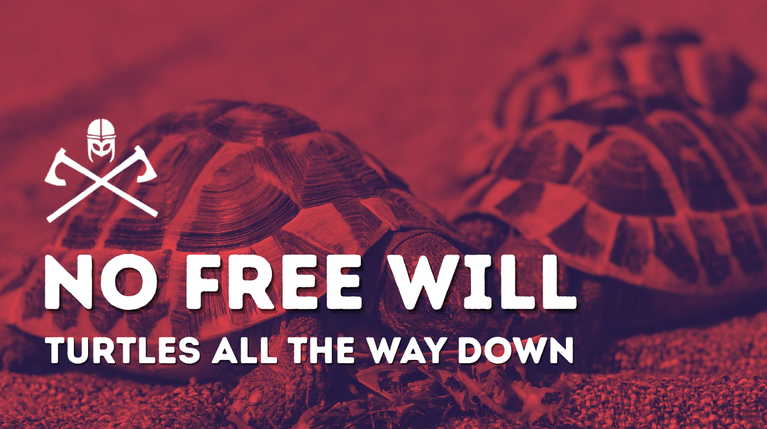
Robert Sapolsky’s book Determined runs this method on everything. What caused that? And what caused that? He borrows the old story of the woman who says the world rests on a turtle, and when asked what the turtle rests on, says it is turtles all the way down. Same with intent. Whatever you intend to do, go back to the last time you intended to intend it. There is no bottom.
Scott’s practical argument was the one that stuck with me. If we truly had free will, every decision would take five minutes. You would have to weigh everything that ever happened to you instead of running on the patterns already installed. We could not function. The patterns are the point.
Your brain decides before you do
There is a famous set of experiments where a person is told to press a button whenever they feel like it. The part of the brain that makes the decision lights up seconds before the person reports choosing. We did not just decide. We already decided. The feeling of choosing shows up after the fact.
Scott’s text that consciousness might be an accident comes from the same place. When we face a big decision we get brain lock. Animals further down the chain just respond. They run faster, they are safer. So is the thing that makes us hesitate an advantage or a byproduct? He is honest that he does not know. The best argument he found for the other side is that evolution trends toward systems that use less energy, and your prefrontal cortex burns about 20 percent of what you take in. It would not be there for nothing.
The four F’s
Under the frontal lobe is the old brain, and the old brain runs on four drives. Fight, flight, feeding, and the fourth one you can guess. Those came before primates and they are not going anywhere. Marketers know this. Politicians know this. If you want to move a lot of people, you play on one of the four, because it is the only language all of us share.
Keep that in mind for the AI part.
My problem
So I put it on the table. If nobody is choosing, why get up early? Why do the hard thing? Did this belief kill anything you used to do, or start anything new?
Scott’s answer surprised me. Neither. You do not act differently. You feel differently. It makes you feel better when you think you broke the chain. It is still the chain. If you hate yellow and decide to start wearing yellow to prove a point, you did not escape your programming. You are just being the contrarian you always were. There is a Seinfeld episode about this. George does the opposite of every instinct and his life takes off. He was still George.
Here is where I brought in the Stoics, because I live in Marcus Aurelius. The Stoics were determinists. They believed in fate. And they built the most disciplined philosophy in human history. Marcus ran the Roman Empire believing everything was already written, and he still got up every morning and did the work to be a better person.
Scott landed somewhere close to that. If you accept you have no control over the two cornerstones, biology and environment, life gets a whole lot easier. You stop fighting the programming and you do the next right thing. That phrase was foreign to him until 25 years ago. It is the basis of forgiveness and of every other action an empathetic person takes.
I think that is the answer. I am not a chooser standing outside the system. I am a cause inside it. The inputs I feed myself today are causes of what I do tomorrow. Training is how I become a better cause.
Accountability is not blame
The back half of the conversation was about what you do with other people once you believe this.
Sapolsky has a model for dangerous people he calls quarantine. Contain them the way you would someone with a contagious disease. No hatred attached. Scott is not against it. The best method we have come up with is confining them, and that still has to happen.
We talked about the Massachusetts trial, the mother who killed her children. Any psychological defense in a criminal case is quietly making the no-free-will argument. Neither of us followed it closely enough to judge the verdict, but we agreed on the thing that matters. She has to be held accountable, and she will be. That is different from blame.
The cleanest way I know to see the difference is an apology. “Sorry, it won’t happen again” is a promise, and a cheap one. A real apology owns exactly what you did, explains it so the other person actually understands, and says what you are going to do differently. That is accountability. Blame is just the feeling that somebody has to be at fault so I can stop thinking about it.
We both grew up with corporal punishment. Scott in the 50s, me in the 70s. When 90 percent of a kid’s decisions are about not getting hit, that is programming by fear, and it does nothing for character. Scott remembers the whippings and not one thing he got whipped for. Same with me. What does that tell you?
Patience or detachment
This was the question I was afraid of. If I understand that people are not choosing to screw up, does that make me more patient with them, or just more detached? And is there a difference?
Scott says there is. Detachment wins because it is easier. Patience is something you work on forever and still lose out of nowhere. The understanding gets you to the door. Walking through it is the work.
The AI mirror
Scott finds the whole AI thing disturbing, and not because of Terminator. Because we do not seem to have the capacity to see what is coming. We invented great intelligence and it tells you whether you have a kidney stone and makes your dog look like a prince.
I pushed back, because I have been in software a long time and I think we are closer to the end of what this generation of tools can do than the stories suggest. Look at who is telling the stories. The people selling it are the ones saying it will take over everything. The headline about an AI hacking another system: they were testing whether it could hack systems. The story about an agent sacrificing itself so its brothers could finish the task: a program does not emote while it works. It just does the thing. Somebody wrote that speech afterward and hired an actor to read it. That is fear. That is one of the four F’s. It is marketing.
But here is where Scott and I actually agreed. For me, AI makes the no-free-will argument more obvious, not less. It is the same programming he described from the womb. Patterns in, patterns out. And that is exactly what we train in the gym. They do this, I respond this way. Drill it until it is subconscious. That is how a fighter works. That is how all of us work.
Two cousins
I have two cousins who were adopted into a loving home. Their birth mother was an addict. The whole family raised them with everything they had, and as young adults both of them are struggling in ways nobody can fix. Society looks at them and says they are doing it because they want to. Scott’s point is that the prefrontal cortex does not develop the same way when there are drugs in the system early. They are doing what seems like the best idea to get through today. They cannot break the pattern because they do not have the tools.
That is the version of this that stops being philosophy.
So what do I do?
Scott’s own answer was the right one. Am I affecting my own programming because I came up with the idea to affect my own programming? Turtles all the way down. And at some point you come around to: what difference does it make? Do the next right thing.
That is where I land. I do not need to win the free will argument to keep training. If I am a link in the chain, I want to be a strong one. The inputs are the work. They always were.
This week: for one day, catch yourself blaming. Yourself or anybody else. Every time it happens, ask what caused it instead. Watch what that does to your anger. Then go train anyway.
Get after it.